The short answer: no, the November 17 blackout is not real
No three-day blackout is scheduled for November 17. No utility, no state agency and no federal agency has announced one.
If you saw the posts and felt uneasy, that is understandable. They were shared millions of times, and they mention a real date. So here is what is actually on the calendar, and the one useful question the rumor leaves behind.
What is really happening on November 17
FEMA, in coordination with the FCC, will run a nationwide test of the Emergency Alert System on Tuesday, November 17, 2026, at 2:20 p.m. Eastern Time. The FCC announced it on September 16 in public notice DA 26-989.
What to expect:
- Where: on radio and television only. FEMA has said this test will not be sent to mobile phones.
- How long: about one minute.
- What it says: that it is a nationwide test and that no action is required by the public.
- Backup date: December 3, 2026, if the test has to be rescheduled.
It is a test of the warning system broadcasters use in a real emergency. It does not touch the power grid, your internet or your phone service. Your lights will stay on.
Where the rumor came from
The posts tie the alert test to a clip from a 2023 episode of an animated TV show that mentions November 17. The date matched, the clip spread, and "alert test" turned into "three days without power" along the way.
Nobody needs to feel foolish for wondering. Checking was the right move.
The real question: what would your home do without power for three days?
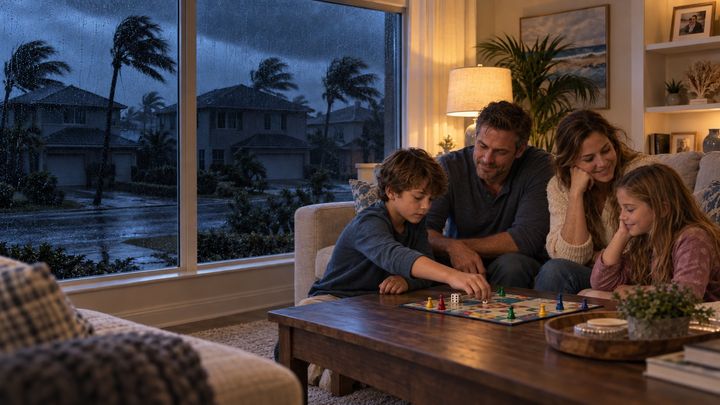
The rumor is false. The question it raised is a fair one, because in Southwest Florida long outages do happen. They just don't come with a date announced in advance.
What actually knocks out power in Southwest Florida
- Hurricanes and tropical storms. After Hurricane Ian in 2022, about 9 out of 10 LCEC customers were without power the next day, and the last ones waited about 12 days. Hurricane Milton in 2024 cut power to roughly 237,000 customers in Lee County.
- Thunderstorms. Fort Myers sees about 89 thunderstorm days a year, more than any other U.S. city, according to National Weather Service data.
- Equipment and grid failures. A damaged line, a failed transformer or a vehicle accident can take out a neighborhood on a clear day.
- Heat. The hottest afternoons are when the grid works hardest and when losing air conditioning matters most.
Our guide on what Ian and Milton taught us about backup power goes deeper into how those outages unfolded.
What stops working at home
A short outage is an inconvenience. A long one in Florida heat is different:
- Air conditioning. The house warms up within hours, and the EPA notes that mold can begin to grow on damp materials in 24 to 48 hours.
- Refrigerator and freezer. The USDA says a refrigerator keeps food safe for about 4 hours without power, and a full freezer for about 48 hours.
- Medical equipment. Oxygen concentrators, CPAP machines and refrigerated medication all depend on electricity. If someone in your home relies on them, talk to their doctor about an outage plan.
- Security and connectivity. Alarm systems, cameras, garage doors, Wi-Fi and phone chargers.
- Well pumps and pool equipment, where the property has them.
Standby generator or portable generator: an honest comparison
Both are real answers to an outage. They solve different problems.
A portable generator
- Start: you roll it out, fuel it, start it and connect it yourself, during or after the storm.
- Fuel: usually gasoline, which you have to store safely and refill.
- What it keeps running: a few selected items, such as a refrigerator, some lights and a fan or a window unit, depending on its size.
- Installation: none for the unit itself. Connecting it to your home's panel safely requires a transfer switch or interlock installed by a licensed electrician.
- Safety: it must run outdoors, well away from doors, windows and the garage, because of carbon monoxide.
- Cost: much lower up front.
- Good fit for: renters, smaller budgets, short outages and people who are home and able to set it up.
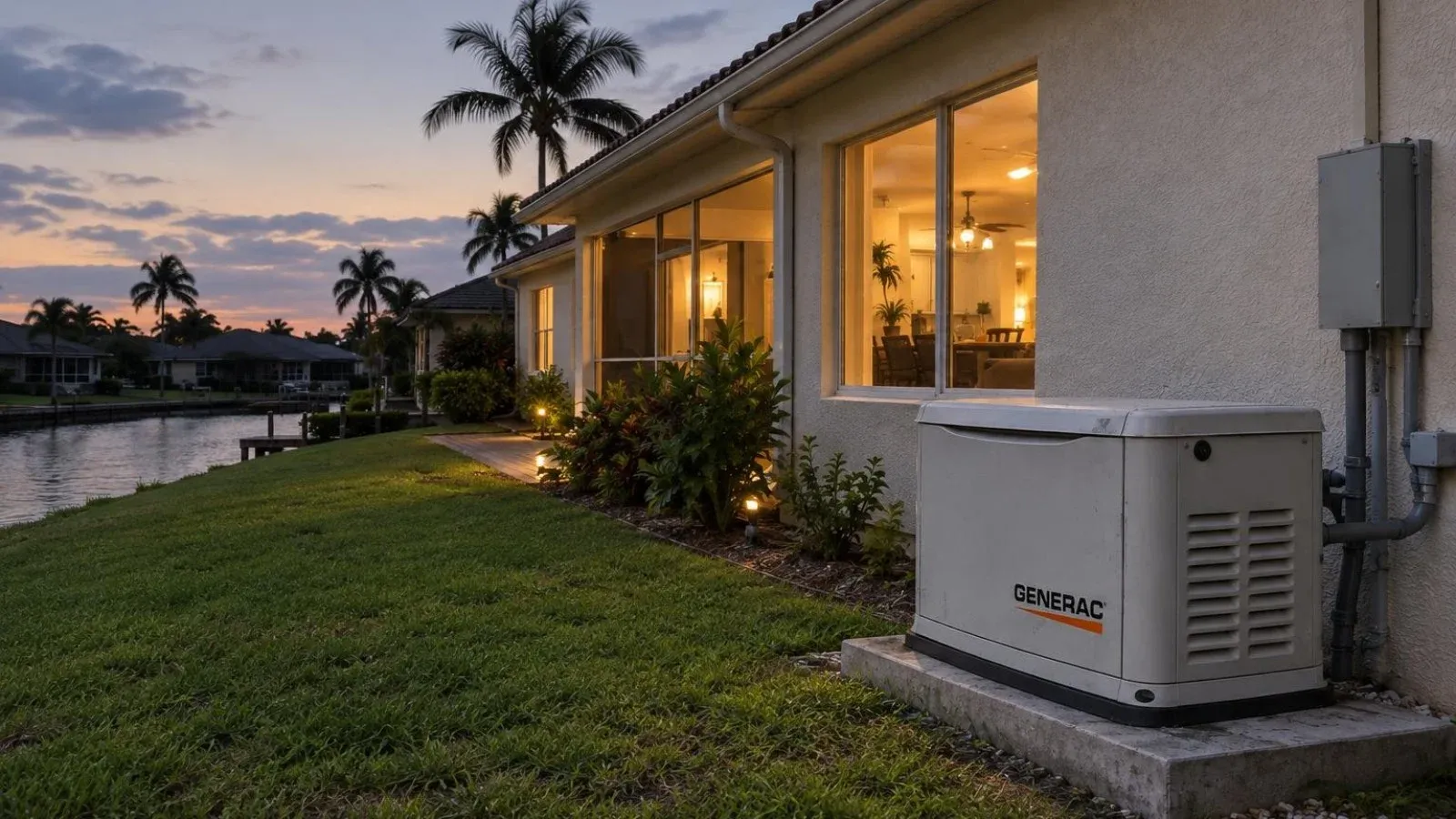
A permanently installed standby generator (such as a Generac)
- Start: it senses the outage and starts by itself, whether you are home, asleep or up north for the summer.
- Fuel: natural gas or propane, connected permanently. Our propane vs. natural gas guide covers the choice.
- What it keeps running: the loads it was sized for, up to the whole home including central air.
- Installation: permits, a pad, a gas connection, an automatic transfer switch and licensed electrical work.
- Cost: a larger investment. Our installed cost guide explains what moves the price.
- Good fit for: homeowners who want central A/C and the full house running, seasonal residents, and households with someone who cannot go without power.
To be clear about where we stand: Gen-Power installs and services permanently installed standby generators. We do not sell portables. A portable is still a reasonable choice for some households, and we would rather you pick the right tool than the wrong one from us.
What a free on-site assessment includes
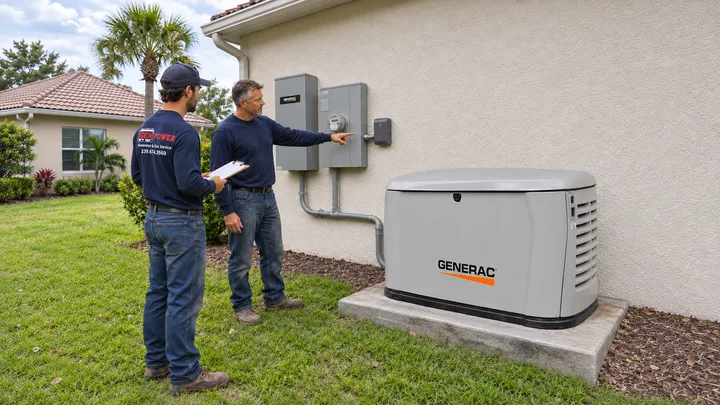
If the rumor made you curious about a standby system, an assessment answers the question for your property, with no obligation. During the visit we:
- Calculate the loads you want to keep running, including the starting demand of each A/C compressor.
- Check whether load management can stage your A/C systems or a larger unit is needed.
- Verify natural gas pressure, or propane tank size and placement.
- Review permits for your jurisdiction and HOA or ARB documents where they apply.
- Confirm placement, clearances and, in a flood zone, the pad elevation.
You then receive a written proposal with the model, the transfer switch and the price.
Frequently asked questions
Is there a blackout on November 17, 2026? No. The only thing scheduled is a one-minute nationwide test of the Emergency Alert System at 2:20 p.m. ET on radio and TV.
Will my phone get an alert? FEMA has said this test airs on radio and TV only and will not be sent to mobile phones.
Do I need to do anything during the test? No. The test message itself says no action is required.
How long can a real outage last in Southwest Florida? Most last minutes or hours. After a major hurricane it can be days, and after Ian some customers waited about 12 days.
Book your free on-site assessment
Gen-Power is a family-owned Generac PowerPro Premier dealer based in Fort Myers, serving Lee, Collier and Charlotte counties from Marco Island to Port Charlotte and North Port, with our own licensed technicians (Florida electrical license EC13008563 and gas license LI45179).
November 17 will come and go with the lights on. If you want to know what your home would need for the day they don't, book a free on-site assessment or see how our installation process works.